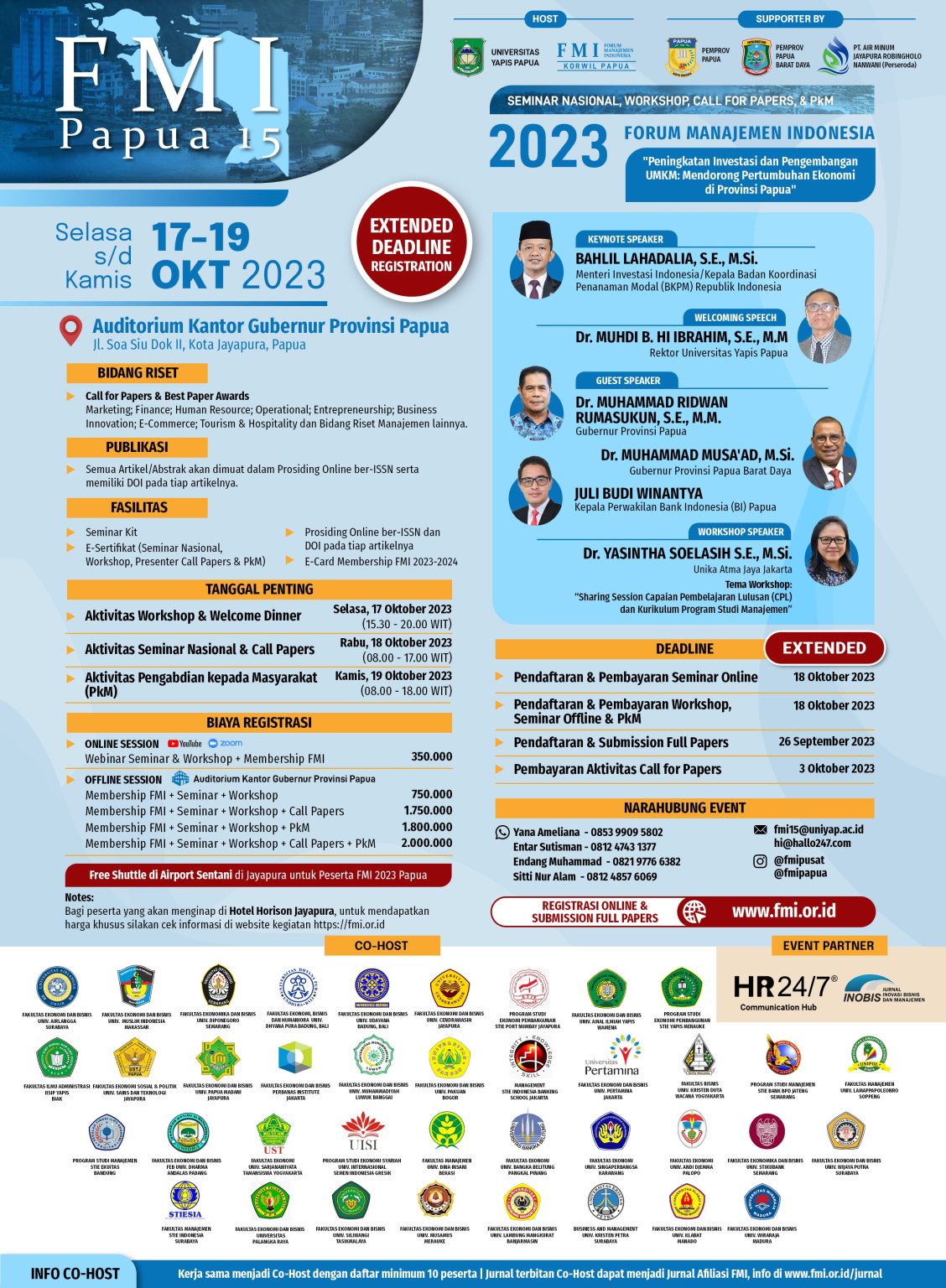
Exploring the Role of Relationship Quality in the Manufacturer-Distributor Context: A Structural Model
DOI:
https://doi.org/10.47747/snfmi.v1i.1461Abstract
This research aims to describe and validate the dimensions of relationship quality essential for the perception of distributors provided by their suppliers (manufacturers). In business-to-business (B2B) relationships, relationship marketing focuses on collaborative efforts to maintain long-term relationships. Therefore, this study considers and expands the understanding of the factors underlying the success of high-quality relationships in B2B. This research sample was taken purposively by distributing questionnaires to managers and supervisors of the distributor company. Second, in-depth interviews were conducted in groups involving academics and practitioners in service quality. This research contributes theoretically by identifying relevant dimensions and proving context-specific definitions. The authors also present managerial implications and recommendations for improving the distributor experience service and the quality of B2B relationships.
References
Anderson, J.C. and Narus, J. A. (1990). A Model of Distributor Firm and Manufacturer Firm Working Partnerships. Journal of Marketing, 54(1), 42. https://doi.org/10.2307/1252172
Anderson, E., & Weitz, B. (1989). Determinants of Continuity in Conventional Industrial Channel Dyads. Marketing Science, 8(4), 310–323. https://doi.org/10.1287/mksc.8.4.310
Chumpitaz, R. and Paparoidamis, N. G. (2004). Service quality and marketing performance in business-to-business markets: exploring the mediating role of client satisfaction. Managing Service Quality, 14, 235–248.
Collins, B. (1999). Pairing Relationship Value and Marketing. Australasian Marketing Journal (AMJ), 7(1), 63–71. https://doi.org/10.1016/S1441-3582(99)70203-X
Concha, J. R. (2013). Manufacturer-Dealer Relationships. The Influence of Trust and Commitment to Technological Interface Adoption. Modern Economy, 04(09), 14–21. https://doi.org/10.4236/me.2013.49a003
Dwyer, F. R., Schurr, P. H., & Oh, S. (1987). Developing Buyer-Seller Relationships. Journal of Marketing, 51(2), 11. https://doi.org/10.2307/1251126
Eggert, A., & Ulaga, W. (2010). Managing customer share in key supplier relationships. Industrial Marketing Management, 39(8), 1346–1355. https://doi.org/10.1016/j.indmarman.2010.03.003
Ferro, C., Padin, C., Svensson, G., & Payan, J. (2016a). Trust and commitment as mediators between economic and non-economic satisfaction in manufacturer-supplier relationships. Journal of Business and Industrial Marketing, 31(1), 13–23. https://doi.org/10.1108/JBIM-07-2013-0154
Ferro, C., Padin, C., Svensson, G., & Payan, J. (2016b). Trust and commitment as mediators between economic and non-economic satisfaction in manufacturer-supplier relationships. Journal of Business and Industrial Marketing, 31(1), 13–23. https://doi.org/10.1108/JBIM-07-2013-0154
Ganesan, S. (1994). Determinants of Long-Term Orientation in Buyer-Seller Relationships. Journal of Marketing, 58(2), 1–19. https://doi.org/10.2307/1252265
Geyskens, I., Steenkamp, J.-B. E. M., & Kumar, N. (1999). Meta-Analysis of Channel Satisfaction in Marketing Relationships. Journal of Marketing Research, 36(2), 223–238.
Lewin, J., Barry, J., & Terry, T. S. (2008). Empirical study of relationship value in industrial services. Journal of Business & Industrial Marketing, 23(4), 228–241. https://doi.org/10.1108/08858620810865807
Mbango, P. (2017). Business-to-business Framework of Relationship Marketing in The South Phineas Mbango , University of South Africa. 21(1), 1–13.
Moore, K. R. (1998). Trust and Relationship Commitment in Logistics Alliances: A Buyer Perspective. International Journal of Purchasing and Materials Management, 34(4), 24–37. https://doi.org/10.1111/j.1745-493X.1998.tb00039.x
Morgan, R. M., & Hunt, S. D. (1994). The commitment-trust theory of relationship marketing. Journal of Marketing, 58(3), 20–38. https://doi.org/10.2307/1252308
Musa, S. bt, Boniface, B., & Tanakinjal, G. (2014). Relationship Marketing Moderating Effect on Value Chain of Horticulture Produce: An Intermediaries’ Perspective. UMK Procedia, 1(October 2013), 82–92. https://doi.org/10.1016/j.umkpro.2014.07.011
Parasuraman, A., Zeithaml, V. A., & Berry, L. L. (1985). substituir_Model Service Its Quality and Implications for Future. Journal of Marketing, 49(Fall 1985), 41–50. https://doi.org/10.1016/S0148-2963(99)00084-3
Prasetya, P., Najib, M., & Soehadi, A. W. (2021). How to Measure Relationship Value in Principal-Retailer Context. Journal of Distribution Science, 19(1), 37–47.
Rajamma, R. K., Zolfagharian, M. A., & Pelton, L. E. (2011). Dimensions and outcomes of B2B relational exchange: A meta-analysis. Journal of Business and Industrial Marketing, 26(2), 104–114. https://doi.org/10.1108/08858621111112285
Rauyruen, P., & Miller, K. E. (2007a). Relationship quality as a predictor of B2B customer loyalty. Journal of Business Research, 60(1), 21–31. https://doi.org/10.1016/j.jbusres.2005.11.006
Rauyruen, P., & Miller, K. E. (2007b). Relationship quality as a predictor of B2B customer loyalty. Journal of Business Research, 60(October 2005), 21–31. https://doi.org/10.1016/j.jbusres.2005.11.006
Ruiz-Martínez, A., Frasquet, M., & Gil-Saura, I. (2019). How to measure B2B relationship value to increase satisfaction and loyalty. Journal of Business and Industrial Marketing, 34(8), 1866–1878. https://doi.org/10.1108/JBIM-10-2018-0289
Samarathunga, S. M. K. M. M., & Newton, S. (2018). Identifying Factors Affecting to Retailer- manufacturer Relationship Continuity Special Reference to Cosmetics Market in Kandy District. 1(February), 1–11. https://doi.org/10.9734/SAJSSE/2018/41630
Sheth, J. (2017). Revitalizing relationship marketing. Journal of Services Marketing, 31(1), 6–10. https://doi.org/10.1108/JSM-11-2016-0397
Strong, C. A., & Morgan, R. E. (2003). Business performance and dimensions of strategic orientation. Journal of Business Research, 56(3), 163–176. http://orca.cf.ac.uk/2700/
Telecom, C. (2017). Key Factors Influencing B2B Relationship Marketing in the Telecommunications Industry. 22–26. https://doi.org/10.1145/3092027.3092034
Tzempelikos, N. (2020). Relationship value in business-to-business markets: a replication and extension of Ulaga and Eggert’s (2006) study. Journal of Business and Industrial Marketing, 35(7), 1273–1288. https://doi.org/10.1108/JBIM-07-2019-0320
Ulaga, W., & Eggert, A. (2006). Relationship value and relationship quality: Broadening the nomological network of business-to-business relationships. European Journal of Marketing, 40(3–4), 311–327. https://doi.org/10.1108/03090560610648075
Wouters, M., Anderson, J. C., & Wynstra, F. (2005). The adoption of total cost of ownership for sourcing decisions –– a structural equations analysis. Accounting, Organization and Society, 30, 167–191. https://doi.org/10.1016/j.aos.2004.03.002
Zineldin, M. (2000). Beyond relationship marketing: Technologicalship marketing. Marketing Intelligence & Planning, 18(1), 9–23. https://doi.org/10.1108/02634500010308549