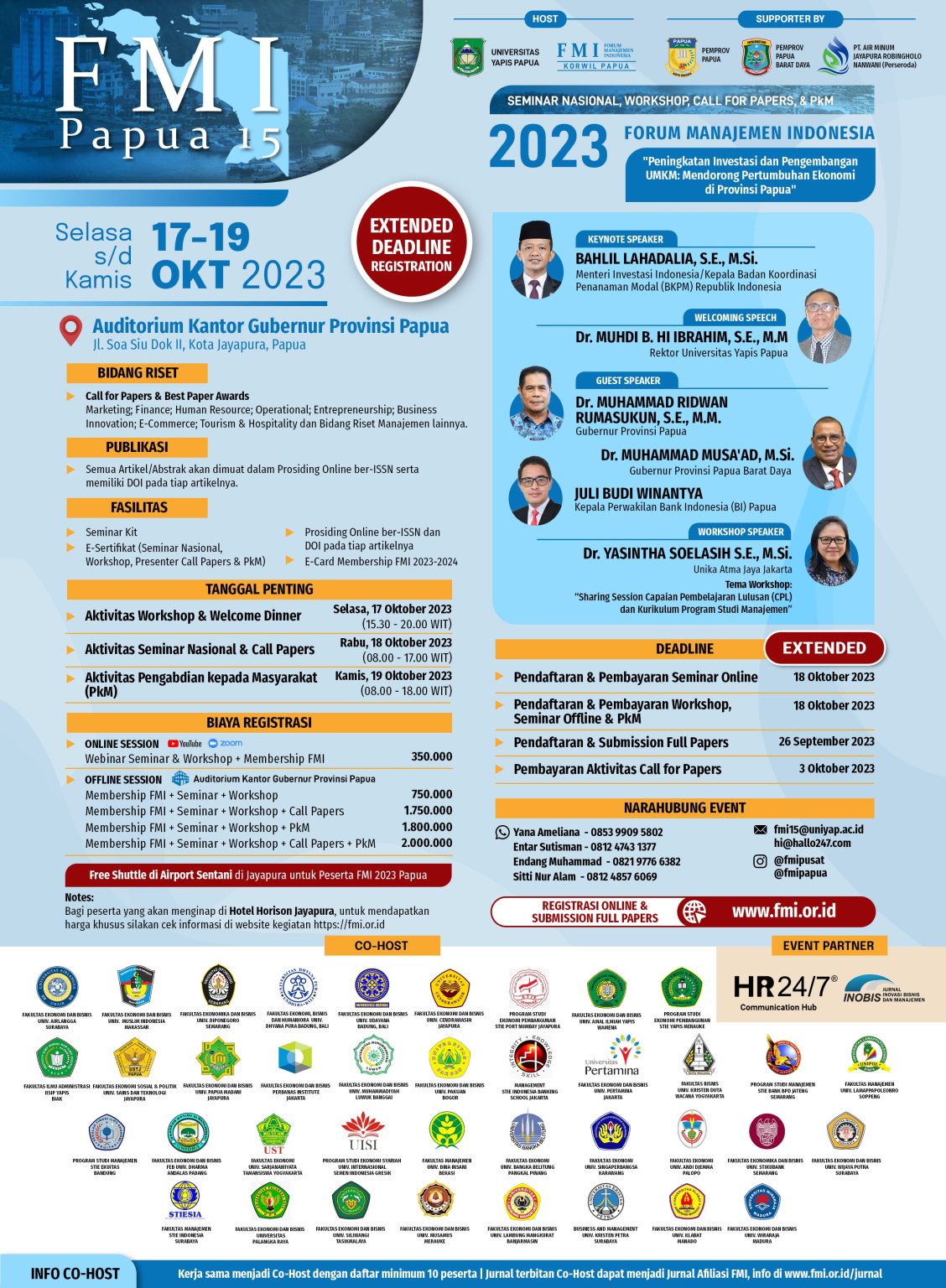
Pengaruh Technology Acceptance Model (TAM) terhadap Repurchase Intention dimediasi oleh Trust pada Pengguna Facebook Marketplace
DOI:
https://doi.org/10.47747/snfmi.v1i.1500Abstract
The rapid growth of online stores drives intense competition in the e-commerce industry. Maintaining customer loyalty and retention in e-commerce platforms can be quite challenging. This study aims to determine the influence of perceived ease of use and perceived usefulness on repurchase intention, mediated by trust, in the Facebook Marketplace application. The research was conducted in Denpasar with 118 respondents. Data collection was performed using Google Forms questionnaires, and the data was analyzed using Partial Least Squares (PLS) analysis. The results indicate that perceived ease of use does not have a positive and significant impact on trust and repurchase intention. Similarly, perceived usefulness does not have a positive and significant effect on trust and repurchase intention. However, trust has a positive and significant influence on repurchase intention. Perceived ease of use and perceived usefulness do not significantly affect repurchase intention among Facebook Marketplace users in Denpasar, Bali, when mediated by trust.
References
Asmarina, N. L. P. G. M., Yasa, N. N. K., & Ekawati, N. W. (2022). The role of satisfaction in mediating the effect of perceived ease of use and perceived usefulness on purchase intention: Study on Bukalapak marketplace’s customer in Bali Province. International Research Journal of Management, IT and Social Sciences, 9(5), 690-706.
Athapaththu, J. C., & Kulathunga, K. M. S. D. (2018). Factors affecting online purchase intention: A study of Sri Lankan online customers.
Chevalier, S. (2022). Key figures on Facebook Marketplace and Facebook Shops 2021. Diunduh dari https://www.statista.com/statistics/1275844/key-figures-facebook-marketplace-shops/
Chua, S. L., Chen, D.-T., & Wong, A. F. (1999). Computer anxiety and its correlates: a meta-analysis. Computers in human behavior, 15(5), 609-623
Compeau, D. R., & Higgins, C. A. (1995). Computer self-efficacy: Development of a measure and initial test. MIS quarterly, 189-211.
DataReportal. (2022), “Digital 2022 Global Digital Overview”. Diunduh dari https://datareportal.com/reports/digital-2022-global-overview-report
Databoks. (2022). Situs E-Commerce dengan Jumlah Pengunjung Terbanyak di Indonesia (Kuartal I 2022). Diunduh dari https://databoks.katadata.co.id/datapublish/2022/07/19/10-e-commerce-dengan-pengunjung-terbanyak-kuartal-i-2022
Davis, F. D. (1986). The technology acceptance model for empirically testing new end-user information systems: theory and results [Ph.D. thesis]. Ph.d.dissertation Massachusetts Institute of Technology.
Davis, F. D. (1989). Perceived usefulness, perceived ease of use, and user acceptance of information technology. MIS quarterly, 319-340.
Davis, F. D., Bagozzi, R. P., & Warshaw, P. R. (1989). User acceptance of computer technology: a comparison of two theoretical models. Management science, 35(8), 982-1003.
Fishbein, M., & Ajzen, I. (1975). Belief, attitude, intention and behavior: An introduction to theory and research. Reading, MA: Addison-Wesley.
Gunawan, F., Ali, M. M., & Nugroho, A. (2019). Analysis of the effects of perceived ease of use and perceived usefulness on consumer attitude and their impacts on purchase decision on PT Tokopedia in Jabodetabek. European Journal of Business and Management Research, 4(5).
Hicks, Marie Jessica.(2005). Delighted Consumers Buy Again. Journal of Consumer Satisfaction,Dissatisfaction and Complaining Behavior, No.18, pp. 94-104.
Kashi, K., & Zheng, C. (2013). Extending Technology Acceptance Model to the E-recruitment Context in I ran. International Journal of Selection and Assessment, 21(1), 121-129.
Kocaleva, M., Stojanovic, I., & Zdravev, Z. (2015). Model of e-learning acceptance and use for teaching staff in Higher Education Institutions. International Journal of Modern Education and Computer Science (IJMECS), 7(4), 23-31.
Laora, S. E., Hidayati, T., & Asnawati, A. (2021). Pengaruh perceived ease of use dan perceived usefulness tehadap repurchase intention yang dimediasi oleh customer trust. KINERJA, 18(2), 304-313.
Lestari, E. A. (2020). Pengaruh Perceived Usefulness, Perceived Ease Of Use, dan Application Content Terhadap Trust Dan Dampaknya Pada Purchase Intention Tiket Perjalanan Dan Hotel Melalui Aplikasi Tiket. Com/Ekatiyas Ayu Lestari/27170425/Pembimbing: Dergibson Siagian.
Moore, G. C., & Benbasat, I. (1991). Development of an instrument to measure the perceptions of adopting an information technology innovation. Information Systems Research, 2(3), 192-222.
Moslehpour, M., Pham, V. K., Wong, W. K., & Bilgiçli, İ. (2018). E-purchase intention of Taiwanese consumers: Sustainable mediation of perceived usefulness and perceived ease of use. Sustainability, 10(1), 234.
NapoleonCat. (2022). Facebook users in Indonesia: January 2022. Diunduh dari https://napoleoncat.com/stats/facebook-users-in-indonesia/2022/01/
Nursetiawan, I., dkk. (2019). Digitalisasi Produk Unggulan Desa Sukamaju Kecamatan Cihaurbeuti Kabupaten Ciamis Berbasis Qr Code dan Facebook Marketplace. Abdimas Galuh Jurnal Pengabdian pada Masyarakat, 1 (1), hal. 67-74
Oktarini, M. A. S., & Wardana, I. M. (2018). Peran Customer Satisfaction Memediasi Pengaruh Perceived Ease of Use dan Perceived Enjoyment terhadap Repurchase Intention. E-Jurnal Manajemen Unud, 7(4), 2041-2072.
Robey, D. "User Attitudes and Management Information System Use," Academy of Management Journal (22:3), September 1979, pp. 527- 538.
Sawitri L. P. W. & Giantari G. A. K. Peran Kepercayaan Memediasi Pengaruh Persepsi Kemudahan Penggunaan dan Persepsi Kegunaan terhadap Repurchase Intention Online. American Journal of Humanilities and Social Science Reseacrch. Volume-4, Issue-1-pp 374-381.
Sabanoglu, T. (2022). Most popular online marketplaces for buying secondhand luxury in the US 2021. Diunduh dari https://www.statista.com/statistics/1259090/most-popular-online-marketplaces-for-second-hand-luxury-us/
Sana, P. A. A., Sri, S. N. W., Kerti, Y. N. N., & Gde, S. I. P. (2019). Technology acceptance model and trust in explaining customer intention to use internet banking. Russian Journal of Agricultural and Socio-Economic Sciences, 91(7), 254-262.
Schultz, R.L. and Slevin, D.P. "Implementation and Organizational Validity: An Empirical Investigation," in Implementing Operations Research/Management Science, R.L. Schultz and D.P. Slevin (eds.), American Elsevier, New York, NY, 1975, pp. 153-182.
Shroff, R. H., Deneen, C. C., & Ng, E. M. (2011). Analysis of the technology acceptance model in examining students' behavioural intention to use an e-portfolio system. Australasian Journal of Educational Technology, 27(4).
Sulistyaningsih, E., dkk. (2022). Strategi Pemasaran Produk UMKM OK OCE ADMA Yogyakarta dengan Memanfaatkan Marketplace di Facebook. Jurnal Abdi Masyarakat Indonesia (JAMSI), 2 (5), hal. 1397-1406
Surendran, P. (2012). Technology Acceptance Model: A Survey of Literature. International Journal of Business & Social Research, 2.
Venkatesh, V., & Davis, F. D. (2000). A theoretical extension of the technology acceptance model: Four longitudinal field studies. Management science, 46(2), 186-204.
Venkatesh, V . (2000). Determinants of perceived ease of use: Integrating control, intrinsic motivation, and emotion into the technology acceptance model. Information Systems Research, 11(4), 342-365.
Venkatesh, V., Morris, M. G., Davis, G. B., & Davis, F. D. (2003). User acceptance of information technology: Toward a unified view. MIS quarterly, 425-478.
Venkatesh, V., & Bala, H. (2008). Technology Acceptance Model 3 and A Research Agenda On Interventions. Decision Sciences, 39(2), 273-315.
Vertinsky, I., Barth, R.T. and Mitchell, V.F. "A Study of OR/MS Implementation as a Social Change Process," in Implementing Operations Research/Management Science, R.L. Schultz and D.P. Slevin (eds.), American Elsevier, New York, NY, 1975, pp. 253-272.
Yudiarti, RFE, & Puspaningrum, A. (2018). Peran Kepercayaan Sebagai Mediasi Antara Pengaruh Persepsi Kegunaan Dan Persepsi Kemudahan Penggunaan Terhadap Minat Membeli E-Book. Jurnal Aplikasi Manajemen, 16(3), 494–502.
Waziana, W., dkk. (2021). Pendampingan Pemasaran Produk Home Industri Melalui Facebook Marketplace bagi Pelaku Umkm di Era Pandemi. Jurnal PkM Pemberdayaan Masyarakat, 2 (2), hal. 39-44