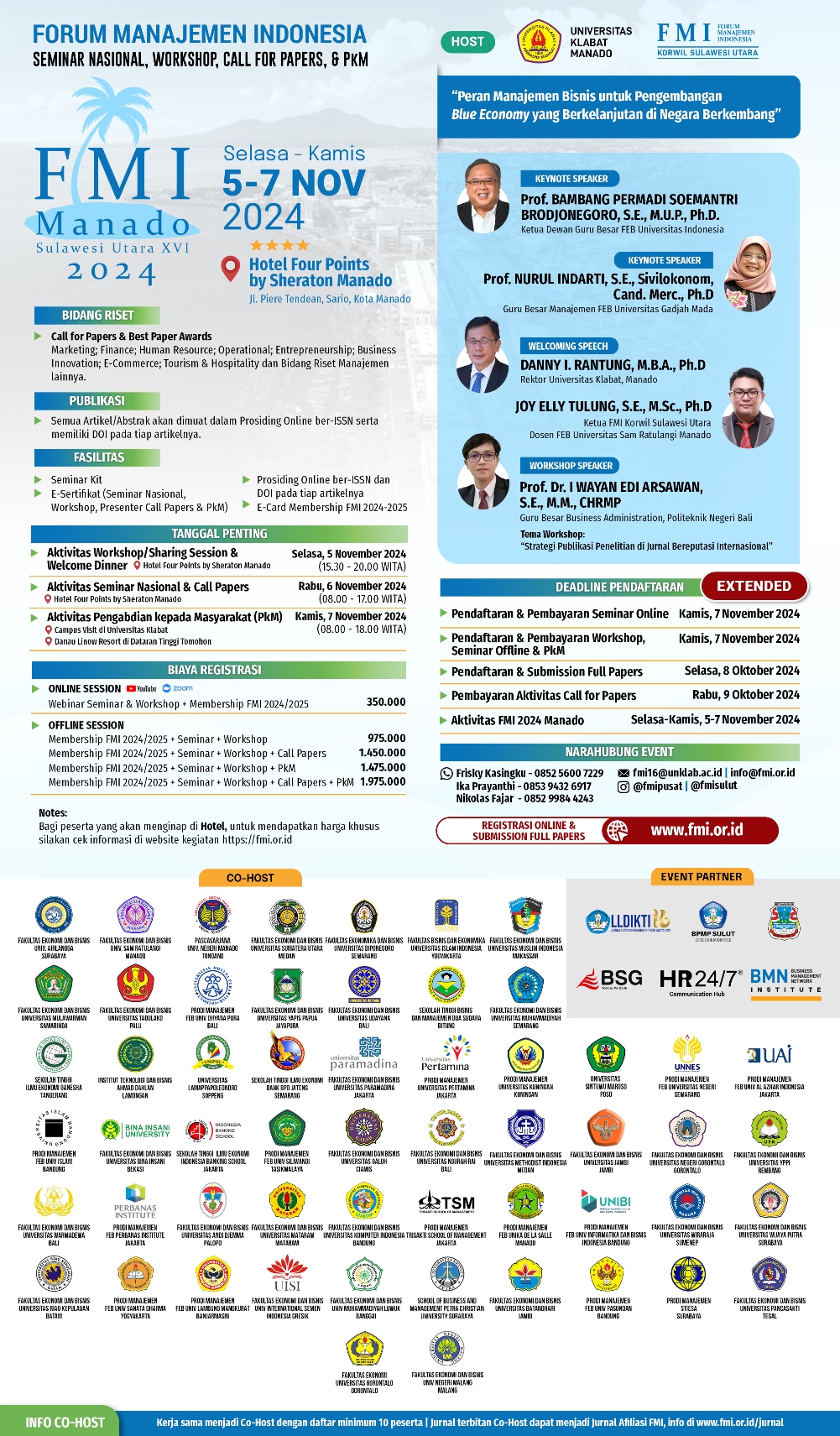
Ketahanan, Literasi dan Kepuasan Finansial: Investigasi pada Guru-Guru Kepala Sekolah
DOI:
https://doi.org/10.47747/snfmi.v2i1.2365Abstract
Personal or family finance is a current insight that teachers in Indonesia need to consider. This study took a sample of 58 teachers currently serving as principals at the kindergarten, elementary, and junior high school levels. This study focuses on the association between financial resilience, financial literacy, and financial satisfaction. Objective measurements of financial literacy are described in more detail to obtain a helpful picture. Furthermore, multiple regression analysis shows the influence of financial resilience on financial satisfaction, but not financial literacy. The results are discussed to provide ideas for future research.
References
Afif, N., & Hidayah, N. (2023). Analysis of financial resilience in Magelang to develop effective policies. Proceedings of the 4th Borobudur International Symposium on Humanities and Social Science 2022 (BIS-HSS 2022), 2022, 931–935. https://doi.org/10.2991/978-2-38476-118-0_106
Agustina, R., Laili, C. N., & Pertiwi, D. A. (2022). The influencing factors of financial satisfaction by moderating financial literacy. Jurnal Economic Resources, 5(1), 10–19. https://doi.org/10.33096/jer.v%vi%i.988
Amelia, M., & Isbanah, Y. (2021). Analisis faktor-faktor yang memengaruhi financial satisfaction pengguna e-wallet. Jurnal Ilmu Manajemen, 9(2), 426–437. https://doi.org/10.26740/jim.v9n2.p426-437
Anand, S., Mishra, K., Verma, V., & Taruna, T. (2021). Financial literacy as a mediator of personal financial health during COVID-19: A structural equation modelling approach. Emerald Open Research, 2, 1–20. https://doi.org/10.35241/emeraldopenres.13735.2
Andrean, & Soejono, F. (2022). Literasi keuangan, minat dalam menggunakan financial technology dan inklusi keuangan guru. Konsumen & Konsumsi: Jurnal Manajemen, 1(1), 21–38. https://journal.ukmc.ac.id/index.php/jkkjm/article/view/744
Antony, J., & Thomas, A. (2023). Direct and indirect effects of subjective financial knowledge with financial satisfaction. Journal of Financial Therapy, 14(1), 66–84. https://doi.org/10.4148/1944-9771.1297
Arifin, A. Z. (2018). Influence factors toward financial satisfaction with financial behavior as intervening variable on Jakarta area workforce. European Research Studies Journal, XXI(Issue 1), 90–103. https://doi.org/10.35808/ersj/932
Caronge, E., Mediaty, Fattah, H., & Khaeril. (2020). Effects of financial attitudes, financial behavior, and financial literacy to financial satisfaction in women workers (case study of female lecturer at Andi Djemma Palopo University). Proceedings of the 4th International Conference on Accounting, Management, and Economics, ICAME, 1–13. https://doi.org/10.4108/eai.25-10-2019.2295387
Çera, G., Khan, K. A., Belas, J., & Ribeiro, H. N. R. (2020). The role of financial capability and culture in financial satisfaction. Economic Papers, 39(4), 389–406. https://doi.org/10.1111/1759-3441.12299
Dare, S. E., van Dijk, W. W., van Dijk, E., van Dillen, L. F., Gallucci, M., & Simonse, O. (2020). The road to financial satisfaction: Testing the paths of knowledge, attitudes, sense of control, and positive financial behaviors. Journal of Financial Therapy, 11(2), 1–30. https://doi.org/10.4148/1944-9771.1240
Hamid, F. S., Loke, Y. J., & Chin, P. N. (2023). Determinants of financial resilience: insights from an emerging economy. Journal of Social and Economic Development, 25(2), 479–499. https://doi.org/10.1007/s40847-023-00239-y
Hidayah, A. P. N., Purbawangsa, I. B. A., & Abundanti, N. (2021). Pengaruh literasi keuangan, perencanaan keuangan dan pendapatan terhadap kesejahteraan keuangan guru perempuan di Kota Denpasar. E-Jurnal Manajemen, 10(7), 672–693. https://doi.org/10.24843/ejmunud.2021.v10.i07.p03
Himawan, N. P., & Wiyanto, H. (2021). Pengaruh financial literacy dan financial attitude terhadap financial satisfaction. Jurnal Manajerial Dan Kewirausahaan, 3(2), 417–425. https://doi.org/10.24912/jmk.v3i2.11888
Hira, T. K., & Mugenda, O. M. (1998). Predictors of financial satisfaction: Differences between retirees and non-retirees. Journal of Financial Counseling and Planning, 9(2), 75–84. https://www.proquest.com/docview/1355866808?sourcetype=Scholarly Journals
Jayasinghe, M., Selvanathan, E. A., & Selvanathan, S. (2020). The financial resilience and life satisfaction nexus of indigenous Australians. Economic Papers, 39(4), 336–352. https://doi.org/10.1111/1759-3441.12296
Jessica, M. W., Anastasia, N., & Pertiwi, D. (2022). Effect of financial literacy and financial behavior of financial satisfaction at professional basketball athletes Indonesia. International Journal of Financial and Investment Studies (IJFIS), 2(2), 92–99. https://doi.org/10.9744/ijfis.2.2.92-99
Kengatharan, N., Kengatharan, L., & Thileepan, M. (2020). Literacy is power and transforms lives: Channelling the relationship between financial literacy and financial satisfaction. Journal of Asia-Pacific Business, 21(4), 315–335. https://doi.org/10.1080/10599231.2020.1831274
Leora, K., Lusardi, A., & van Oudheusden, P. (2015). Financial literacy around the world: Insights from the Standard & Poor’s ratings services global financial literacy survey. https://gflec.org/wp-content/uploads/2015/11/Finlit_paper_16_F2_singles.pdf
Lusardi, A., Hasler, A., & Yakoboski, P. J. (2021). Building up financial literacy and financial resilience. Mind and Society, 20(2), 181–187. https://doi.org/10.1007/s11299-020-00246-0
Madinga, N. W., Maziriri, E. T., Chuchu, T., & Magoda, Z. (2022). An investigation of the impact of financial literacy and financial socialization on financial satisfaction: Mediating role of financial risk attitude. Global Journal of Emerging Market Economies, 14(1), 60–75. https://doi.org/10.1177/09749101211070952
Mahdzan, N. S., Sukor, M. E. A., Zainudin, R., Zainir, F., & Ahmad, W. M. W. (2023). A comparison of financial well-being and its antecedents across different employment categories in Malaysia. Gadjah Mada International Journal of Business, 25(3), 255–277. https://doi.org/10.22146/gamaijb.73947
Mahmoud, M. A., Umar, U. H., Ado, M. B., & Kademi, T. T. (2024). Factors influencing the financial satisfaction of MSME owners: The mediating role of access to Islamic financing. Management Research Review, 47(3), 422–440. https://doi.org/10.1108/MRR-01-2022-0047
Mindra, R., & Moya, M. (2017). Financial self-efficacy: A mediator in advancing financial inclusion. Equality, Diversity and Inclusion: An International Journa, 36(2), 128–149. https://doi.org/10.1108/EDI-05-2016-0040
Mundi, H. S., & Vashisht, S. (2023). Cognitive abilities and financial resilience: Evidence from an emerging market. International Journal of Bank Marketing, 41(5), 1010–1036. https://doi.org/10.1108/IJBM-05-2022-0216
Nabila, F. S., Fakhri, M., Pradana, M., Kartawinata, B. R., & Silvianita, A. (2023). Measuring financial satisfaction of Indonesian young adults: A SEM-PLS analysis. Journal of Innovation and Entrepreneurship, 12(16), 1–13. https://doi.org/10.1186/s13731-023-00281-4
Normawati, R. A., Rahayu, S. M., & Worokinasih, S. (2022). Financial satisfaction on millennials: Examining the relationship between financial knowledge, digital financial knowledge, financial attitude, and financial behavior. Journal of Applied Management, 20(2), 354–365. https://doi.org/10.21776/ub.jam.2022.020.02.12
Obaid, H. J., Hama, K. N. K., & Yasir, M. H. (2023). The Role of financial literacy in achieving financial satisfaction through financial well-being. International Journal of Professional Business Review, 8(7), 1–18. https://doi.org/10.26668/businessreview/2023.v8i7.1607
Owusu, G. M. Y. (2023). Predictors of financial satisfaction and its impact on psychological wellbeing of individuals. Journal of Humanities and Applied Social Sciences, 5(1), 59–76. https://doi.org/10.1108/jhass-05-2021-0101
Pahlevan Sharif, S., Naghavi, N., Sharif Nia, H., & Waheed, H. (2020). Financial literacy and quality of life of consumers faced with cancer: A moderated mediation approach. International Journal of Bank Marketing, 38(5), 1009–1031. https://doi.org/10.1108/IJBM-10-2019-0355
Pearson, B., & Korankye, T. (2023). The association between financial literacy confidence and financial satisfaction. Review of Behavioral Finance, 15(6), 935–946. https://doi.org/10.1108/RBF-03-2022-0090
Rahayu, S. M., Worokinasih, S., Damayanti, C. R., Rachmatika, A. G., Normawati, R. A., & Aprilian, Y. A. (2022). Conceptualizing of financial resilient: Building money management behavior. Proceedings of the Fifth Annual International Conference on Business and Public Administration (AICoBPA 2022), 1, 709–721. https://doi.org/10.2991/978-2-38476-090-9_56
Rahman, M., Isa, C. R., Masud, M. M., Sarker, M., & Chowdhury, N. T. (2021). The role of financial behaviour, financial literacy, and financial stress in explaining the financial well-being of B40 group in Malaysia. Future Business Journal, 7(1), 1–18. https://doi.org/10.1186/s43093-021-00099-0
Rusdini, D. A. (2021). Faktor yang memengaruhi financial satisfaction pada masyarakat Kabupaten Pamekasan. Jurnal Ilmu Manajemen, 9(1), 182–190. https://doi.org/10.26740/jim.v9n1.p182-190
Sabri, M. F., Cook, C. C., & Gudmunson, C. G. (2012). Financial well‐being of Malaysian college students. Asian Education and Development Studies, 1(2), 153–170. https://doi.org/10.1108/20463161211240124
Sarpong-Kumankoma, E., Ab-Bakar, S., & Akplehey, F. N. (2023). Gender and financial literacy in Ghana. African Journal of Economic and Management Studies, 14(4), 569–582. https://doi.org/10.1108/AJEMS-04-2022-0171
Sherlyani, M., & Pamungkas, A. S. (2020). Pengaruh financial behavior, risk tolerance, dan financial strain terhadap financial satisfaction. Jurnal Manajerial Dan Kewirausahaan, 2(1), 272–281. https://doi.org/10.24912/jmk.v2i1.7468
Sumani, S., Awwaliyah, I. N., Suryaningsih, I. B., & Nurdin, D. (2022). Financial behavior on financial satisfaction and performance of the Indonesian batik industry. Journal of Applied Management, 20(4), 820–832. https://doi.org/10.21776/ub.jam.2022.020.04.06
Tahir, M. S., Shahid, A. U., & Richards, D. W. (2022). The role of impulsivity and financial satisfaction in a moderated mediation model of consumer financial resilience and life satisfaction. International Journal of Bank Marketing, 40(4), 773–790. https://doi.org/10.1108/IJBM-09-2021-0407
Woodyard, A. S., & Robb, C. A. (2016). Consideration of financial satisfaction: What consumers know, feel and do from a financial perspective. Journal of Financial Therapy, 7(2), 41–61. https://doi.org/10.4148/1944-9771.1102
Yadav, P., & Shaikh, I. (2023). Measuring financial resilience with consumer sentiment data from India. International Journal of Bank Marketing, 41(5), 1083–1103. https://doi.org/10.1108/IJBM-07-2022-0325
Yao, R., & Zhang, J. (2023). Employment status and financial resilience during the COVID-19 pandemic. International Journal of Bank Marketing, 41(5), 992–1009. https://doi.org/10.1108/IJBM-08-2022-0371
Yap, R. J. C., Komalasari, F., & Hadiansah, I. (2018). The Effect of financial literacy and attitude on financial management behavior and satisfaction. BISNIS & BIROKRASI: Jurnal Ilmu Administrasi Dan Organisasi, 23(3), 140–146. https://doi.org/10.20476/jbb.v23i3.9175
Zarkasyi, M. I., & Purwanto, E. (2022). Pengaruh literasi keuangan, financial technology, dan gaya hidup terhadap perilaku keuangan guru taman kanak-kanak. Al-Kharaj : Jurnal Ekonomi, Keuangan & Bisnis Syariah, 4(2), 290–307. https://doi.org/10.47467/alkharaj.v4i2.640
Zulfiqar, M., & Bilal, M. (2016). Financial wellbeing is the goal of financial literacy. Research Journal of Finance and Accounting, 7(11), 94–103. https://www.iiste.org/Journals/index.php/RJFA/article/view/31504/32344