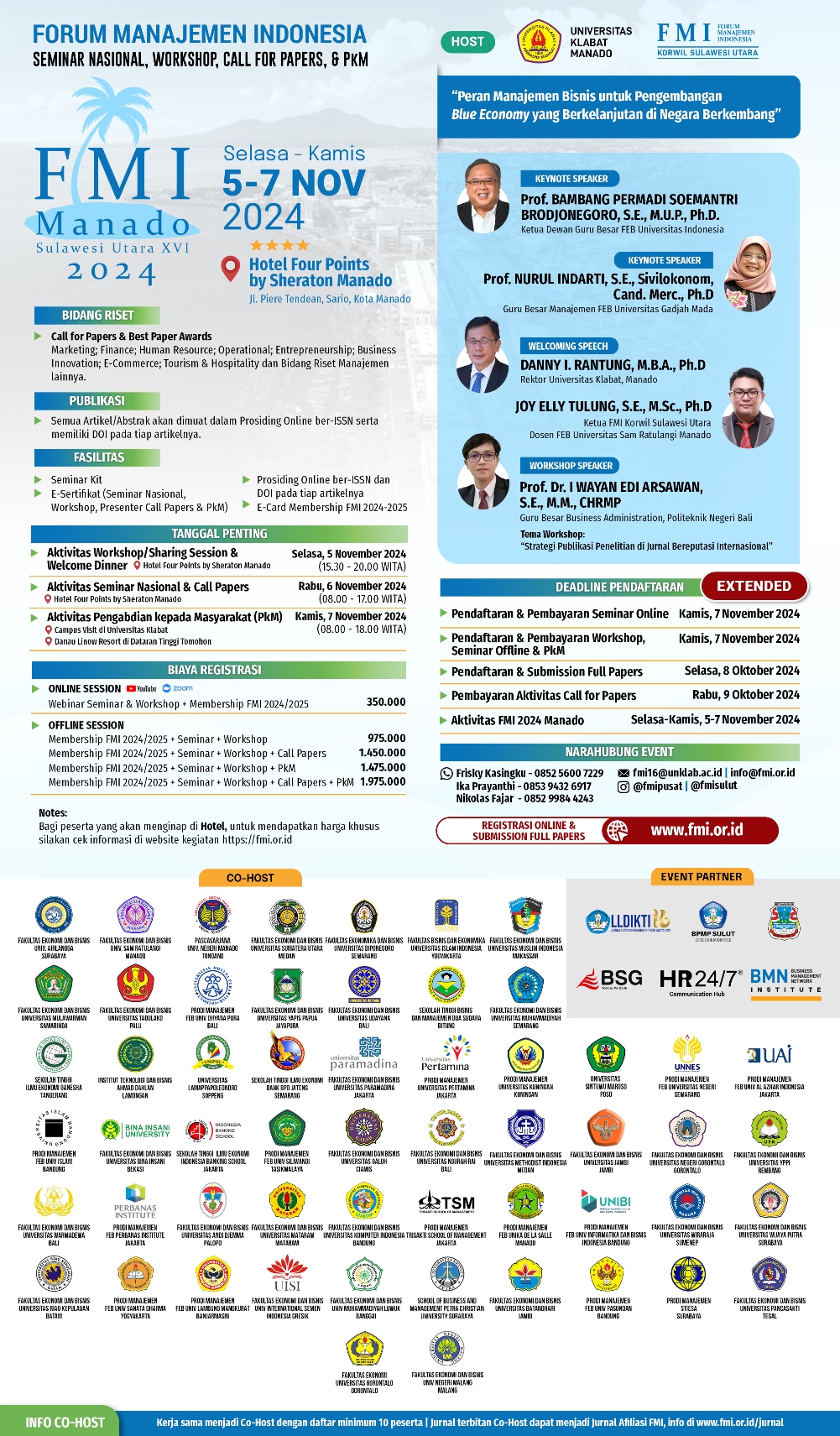
Financial Well-Being dan Niat untuk Memanfaatkan Layanan FinTech: Sebuah Studi Empiris
DOI:
https://doi.org/10.47747/snfmi.v2i1.2372Abstract
This research tests whether Financial Well-Being influences the Intention to Use FinTech Services. The research model was analyzed from 33 student respondents at the Management Study Program at Tadulako University, Palu, Central Sulawesi, Indonesia. The research sample was determined based on an Accidental Sampling technique. A quantitative approach is used as a data analysis method. Data were analyzed using multiple regression analysis (MRA) and descriptive statistical analysis. The research results show that Financial Well-Being significantly affects a person's intention to use FinTech services.
References
Alwi, S., & Al, E. (2021). FinTech As Financial Inclusion: Factors Affecting Behavioral Intention To Accept Mobile E-Wallet During Covid-19 Outbreak. Turkish Journal Of Computer And Mathematics Education (Turcomat), 12(7), Article 7.
Barrafrem, K., Tinghög, G., & Västfjäll, D. (2021). Trust In The Government Increases Financial Well-Being And General Well-Being During Covid-19. Journal Of Behavioral And Experimental Finance, 31, 100514. Https://Doi.Org/10.1016/J.Jbef.2021.100514
Eberhardt, W., Brüggen, E., Post, T., & Hoet, C. (2021). Engagement Behavior And Financial Well-Being: The Effect Of Message Framing In Online Pension Communication. International Journal Of Research In Marketing, 38(2), 448–471. Https://Doi.Org/10.1016/J.Ijresmar.2020.11.002
Gupta, K., Wajid, A., & Gaur, D. (2023). Determinants Of Continuous Intention To Use FinTech Services: The Moderating Role Of Covid-19. Journal Of Financial Services Marketing. Https://Doi.Org/10.1057/S41264-023-00221-Z
Hermawan, A., Gunardi, A., & Sari, L. M. (2022). Intention To Use Digital Finance Msmes: The Impact Of Financial Literacy And Financial Inclusion. Jurnal Ilmiah Akuntansi Dan Bisnis, 17(1). Https://Doi.Org/10.24843/Jiab.2022.V17.I01.P12
Liébana-Cabanillas, F., Marinkovic, V., Ramos De Luna, I., & Kalinic, Z. (2018). Predicting The Determinants Of Mobile Payment Acceptance: A Hybrid Sem-Neural Network Approach. Technological Forecasting And Social Change, 129(C), 117–130.
Liébana-Cabanillas, F., Ramos De Luna, I., & Montoro-Ríos, F. J. (2015). User Behaviour In Qr Mobile Payment System: The Qr Payment Acceptance Model. Technology Analysis & Strategic Management, 27(9), 1031–1049. Https://Doi.Org/10.1080/09537325.2015.1047757
Muir, K. H., M, N., Marjolin, A., Salignac, F., & Saunders, P. (2017). Exploring Financial Wellbeing In The Australian Context—Final Report.
Ozili, P. K. (2018). Impact Of Digital Finance On Financial Inclusion And Stability. Borsa Istanbul Review, 18(4), 329–340. Https://Doi.Org/10.1016/J.Bir.2017.12.003
Phuong, N. T. H., Thuy, N. D., Giang, T. L., Han, B. T. N., Hieu, T. H., & Long, N. T. (2022). Determinants Of Intention To Use FinTech Payment Services: Evidence From Vietnam’s Generation Z. 26(1).
Ryu, H.-S. (2018). What Makes Users Willing Or Hesitant To Use FinTech?: The Moderating Effect Of User Type. Industrial Management & Data Systems, 118(3), 541–569. Https://Doi.Org/10.1108/Imds-07-2017-0325
Sorensen, E. (2018, May 31). Different Types Of Mobile Payments Explained. Mobile transaction. Https://Www.Mobiletransaction.Org/Different-Types-Of-Mobile-Payments