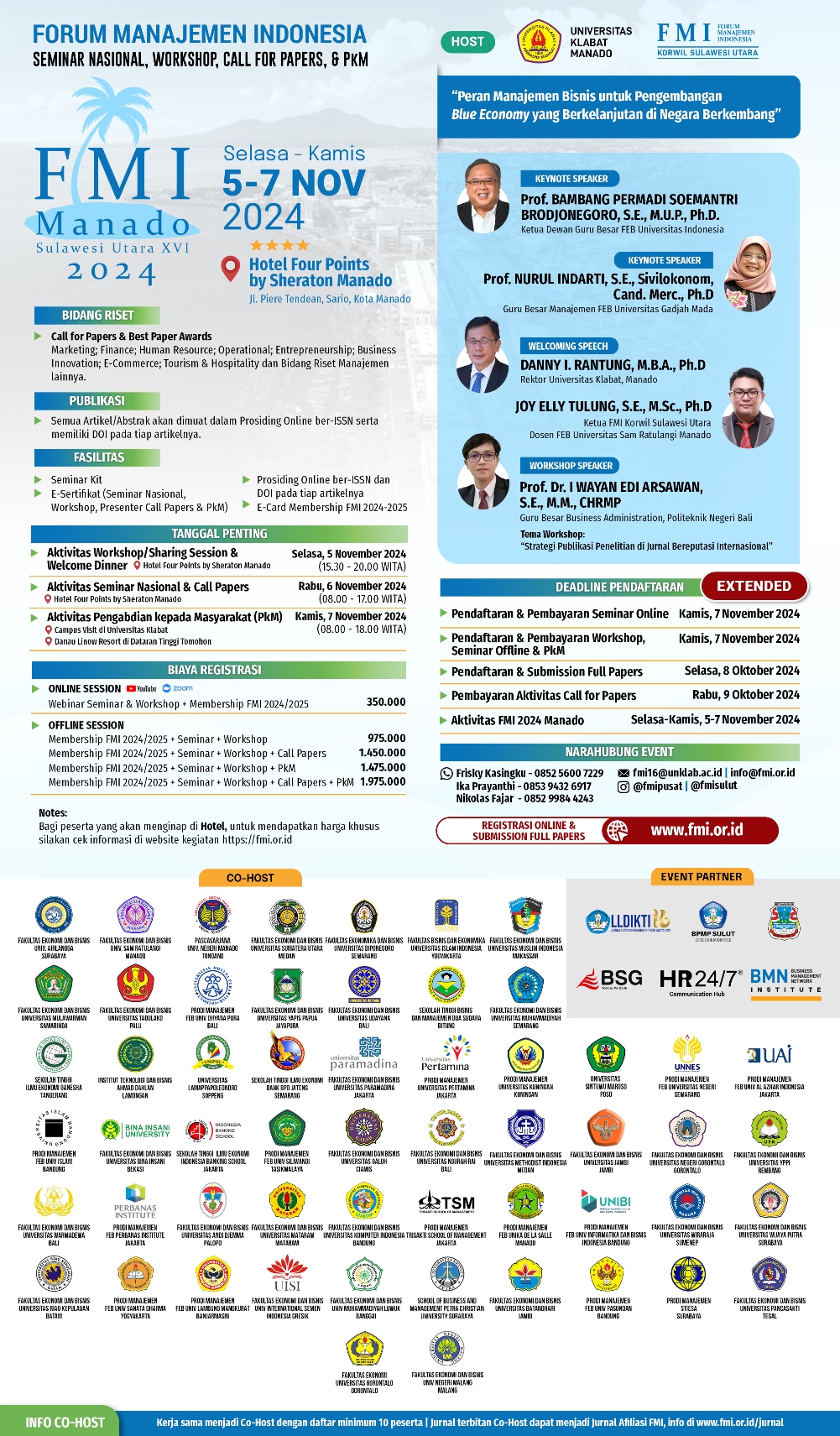
Assessment the Antecedent of Sustainable National Economy Growth (Green, Blue, Brown & Orange Economy) through Green Business Management Practices in Developing Countries: Evidences from Indonesia
DOI:
https://doi.org/10.47747/snfmi.v2i1.2395Abstract
Current research investigates the impact of green, blue, brown and orange economy on National Economy Growth. Putting forward the sustainability in the global context, these economies become crucial paradigm to leverage inclusive and sustainable economy development. GE focused on carbon emission reduction, increase resources efficiency, ecosystem protection, BE emphasized on the marine sustainable resources to push growth. Brown referred on traditional economy model that dependable on natural resources (unrenewable) and produced high greenhouse gas emissions, while OE is dealing with economy creative covered industries (art, culture, entertainment and innovation). Deploying quantitative method approach with secondary data from multi resources, such as government report, national data statistics and also Indonesia large scale enterprises. The analysis conducted to measure the contribution of related economy on national economy development through Green Business Management Practices as intervening variable. Research findings showed the economy categories had huge potency to increase national economy performance. The findings also highlighted the integration of four economies into national strategy development as pivotal step to maintain long term sustainability. Policy recommendation suggested to increase investment, environmental technology, human capacity development, strengthening cooperation within sectors and collaboration among countries and natural resource management.
References
Alhaimer, R. S. (2021). The Role of Social Media in the Innovation and Performance of Kuwaiti Enterprises in the Food Sector. Journal of Theoretical and Applied Electronic Commerce Research, 16(6), 1960-1972. doi: 10.3390/jtaer16060110
Ameer R, & R, O. (2012). Sustainability practices and corporate financial performance: a study based on the top global corporations. . J Bus Ethics, 108(1), 61-79.
Anbleyth-Evans, J., Leiva, F. A., Gaymer, C. F., Abel, R. R. A., Campos, L., & Hidalgo, C. (2024). From a Brown to a blue economy in Chile. Environmental Challenges, 14, 100846. doi: 10.1016/j.envc.2024.100846
Axon, S., & Collier, S. (2023). Breaking Blue: Establishing comprehensive policy for a just and inclusive transition for the Blue Economy. Marine Policy, 147, 105343. doi: 10.1016/j.marpol.2022.105343
Badjeena, B. P., Ali, E., Wonyra, K. O., & Tamou, K. (2024). Green entrepreneurship: Opportunities and challenges for the transition to a circular economy in Togo, West Africa. World Development Sustainability, 5, 100181. doi: 10.1016/j.wds.2024.100181
Banerjee, A. K. (2024). Environmental sustainability and the time-varying changing dynamics of green and brown energy ETFs. Finance Research Letters, 62, 105148. doi: 10.1016/j.frl.2024.105148
Benzaken, D., Adam, J. P., Virdin, J., & Voyer, M. (2024). From concept to practice: financing sustainable blue economy in Small Island Developing States, lessons learnt from the Seychelles experience. Marine Policy, 163, 106072. doi: 10.1016/j.marpol.2024.106072
Bi, C., Jin, S., Li, S., & Li, Y. n. (2023). Can green advertising increase consumers' purchase intention of electric vehicles? An experimental study from China. Journal of Cleaner Production, 419, 138260. doi: 10.1016/j.jclepro.2023.138260
Brito, J. A. F., Nguyen, T. V., & Kristófersson, D. M. (2024). Evaluating the sustainability and potential of the Blue Economy: A bioeconomic and input–output analysis of the fisheries sector in Cape Verde. Ocean & Coastal Management, 250, 107042. doi: 10.1016/j.ocecoaman.2024.107042
Carballo-Penela, A., & Castroman-Diz, J. L. (2015). Environmental policies for sustain- able development: An analysis of the drivers of proactive environmental strategies in the service sector. Business Strategy and the Environment, 24(8), 802-818.
Carnes, C. M., Chirico, F., Hitt, M. A., Huh, D. W., & Pisano, V. (2017). Resource orchestration for innovation: structuring and bundling resources in growth-and maturitystage firms. . Long Range Planning, 50, 472-486.
Dong, X., Guo, K., & Zhao, X. (2024). Does digital economy promote regional green innovation? An empirical study based on the transmission effect and threshold effect of marketization. Journal of Digital Economy, 3, 47-61. doi: 10.1016/j.jdec.2024.07.002
Fudge, M., Ogier, E., & Alexander, K. A. (2023). Marine and coastal places: Wellbeing in a blue economy. Environmental Science & Policy, 144, 64-73. doi: 10.1016/j.envsci.2023.03.002
Fusco, L. M., Knott, C., Cisneros-Montemayor, A. M., Singh, G. G., & Spalding, A. K. (2022). Blueing business as usual in the ocean: Blue economies, oil, and climate justice. Political Geography, 98, 102670. doi: 10.1016/j.polgeo.2022.102670
Graziano, M., Alexander, K. A., McGrane, S. J., Allan, G. J., & Lema, E. (2022). The many sizes and characters of the Blue Economy. Ecological Economics, 196, 107419. doi: 10.1016/j.ecolecon.2022.107419
He, W., Yao, X., Sun, X., Le, W., & Yi, R. (2024). Dynamic spillovers of green, brown, and financial industries under the low-carbon transition: Evidence from China. Energy Economics, 139, 107901. doi: 10.1016/j.eneco.2024.107901
Helfat, C. E., Finkelstein, S., Mitchell, W., Peteraf, M., Singh, H., Teece, D., & Winter, S. G. (2007). Dynamic Capabilities: Understanding Strategic Change in Organizations. Malden, MA: Blackwell.
Hong Nham, N. T., Mai Hoa, T. T., & Ha, L. T. (2023). Influences of digitalization on sustaining marine minerals: A path toward sustainable blue economy. Ocean & Coastal Management, 239, 106589. doi: 10.1016/j.ocecoaman.2023.106589
Hossain, M. A., Islam, M. N., Fatima, S., Kibria, M. G., Ullah, E., & Hossain, M. E. (2024). Pathway toward sustainable blue economy: Consideration of greenhouse gas emissions, trade, and economic growth in 25 nations bordering the Indian ocean. Journal of Cleaner Production, 437, 140708. doi: 10.1016/j.jclepro.2024.140708
Judge, T. A., Thoresen, C. J., Pucik, V., & Welbourne, T. M. (1999). Managerial coping with organizational change: A dispositional perspective. Journal of Applied psychology, 84(1), 107-122. doi: 10.1037/0021-9010.84.1.107
Lyons, P., Mynott, S., & Melbourne-Thomas, J. (2023). Enabling Indigenous innovations to re-centre social licence to operate in the Blue Economy. Marine Policy, 147, 105384. doi: 10.1016/j.marpol.2022.105384
Meet, R. K., Kundu, N., & Ahluwalia, I. S. (2024). Does socio demographic, green washing, and marketing mix factors influence Gen Z purchase intention towards environmentally friendly packaged drinks? Evidence from emerging economy. Journal of Cleaner Production, 434, 140357. doi: 10.1016/j.jclepro.2023.140357
Miklenčičová, R. (2015). Perception of Environmental Product Labelling by Slovak Consumers. Procedia Economics and Finance, 34, 644-648. doi: 10.1016/s2212-5671(15)01680-9
Nham, N. T. H., & Ha, L. T. (2023). The role of financial development in improving marine living resources towards sustainable blue economy. Journal of Sea Research, 195, 102417. doi: 10.1016/j.seares.2023.102417
Niner, H. J., Barut, N. C., Baum, T., Diz, D., Laínez del Pozo, D., Laing, S., . . . Rees, S. (2022). Issues of context, capacity and scale: Essential conditions and missing links for a sustainable blue economy. Environmental Science & Policy, 130, 25-35. doi: 10.1016/j.envsci.2022.01.001
Ogiemwonyi, O., Alam, M. N., Alshareef, R., Alsolamy, M., Azizan, N. A., & Mat, N. (2023). Environmental factors affecting green purchase behaviors of the consumers: Mediating role of environmental attitude. Cleaner Environmental Systems, 10, 100130. doi: 10.1016/j.cesys.2023.100130
Pace, L. A., Saritas, O., & Deidun, A. (2023). Exploring future research and innovation directions for a sustainable blue economy. Marine Policy, 148, 105433. doi: 10.1016/j.marpol.2022.105433
Saddington, L. (2023). Geopolitical imaginaries in climate and ocean governance: Seychelles and the Blue Economy. Geoforum, 139, 103682. doi: 10.1016/j.geoforum.2023.103682
Sanchez, A. M., Vicente-Oliva, S., & Perez-Perez, M. (2020). The relationship between R&D, the absorptive capacity of knowledge, human resource flexibility and innovation: Mediator effects on industrial firms. Journal of business research, 118, 431-440.
Sirmon, D. G., Hitt, M. A., & Ireland, R. D. (2007). Managing firm resources in dynamic environments to create value: looking inside the black box. . Academy of Management Review, 32, 273-292.
Taufique, K. M. R., Siwar, C., Chamhuri, N., & Sarah, F. H. (2016). Integrating General Environmental Knowledge and Eco-Label Knowledge in Understanding Ecologically Conscious Consumer Behavior. Procedia Economics and Finance, 37, 39-45. doi: 10.1016/s2212-5671(16)30090-9
Tiwari, S., & Si Mohammed, K. (2024). Unraveling the impacts of linear economy, circular economy, green energy and green patents on environmental sustainability: Empirical evidence from OECD countries. Gondwana Research, 135, 75-88. doi: 10.1016/j.gr.2024.07.018
Zaccaro, S. J., & Banks, D. J. (2001). Leadership, vision, and organizational effectiveness”, The Nature of Organizational Leadership: Understanding the Performance Imperatives Confronting Today’s Leaders. 181-218.
Zhang, H., Wei, S., Guo, Y., & Gao, W. (2024). Analyzing the interconnection between rare earth market and green economy: Time-varying effects of trade policy uncertainty. Resources Policy, 97, 105262. doi: 10.1016/j.resourpol.2024.105262
Zhang, S., & Wei, Y. (2024). Assessing the effects of different types of environmental supervision policies on green economy efficiency of China. J Environ Manage, 368, 122282. doi: 10.1016/j.jenvman.2024.122282
Zhao, Z., Zhao, Y., Shi, X., Zheng, L., Fan, S., & Zuo, S. (2024). Green innovation and carbon emission performance: The role of digital economy. Energy Policy, 195, 114344. doi: 10.1016/j.enpol.2024.114344