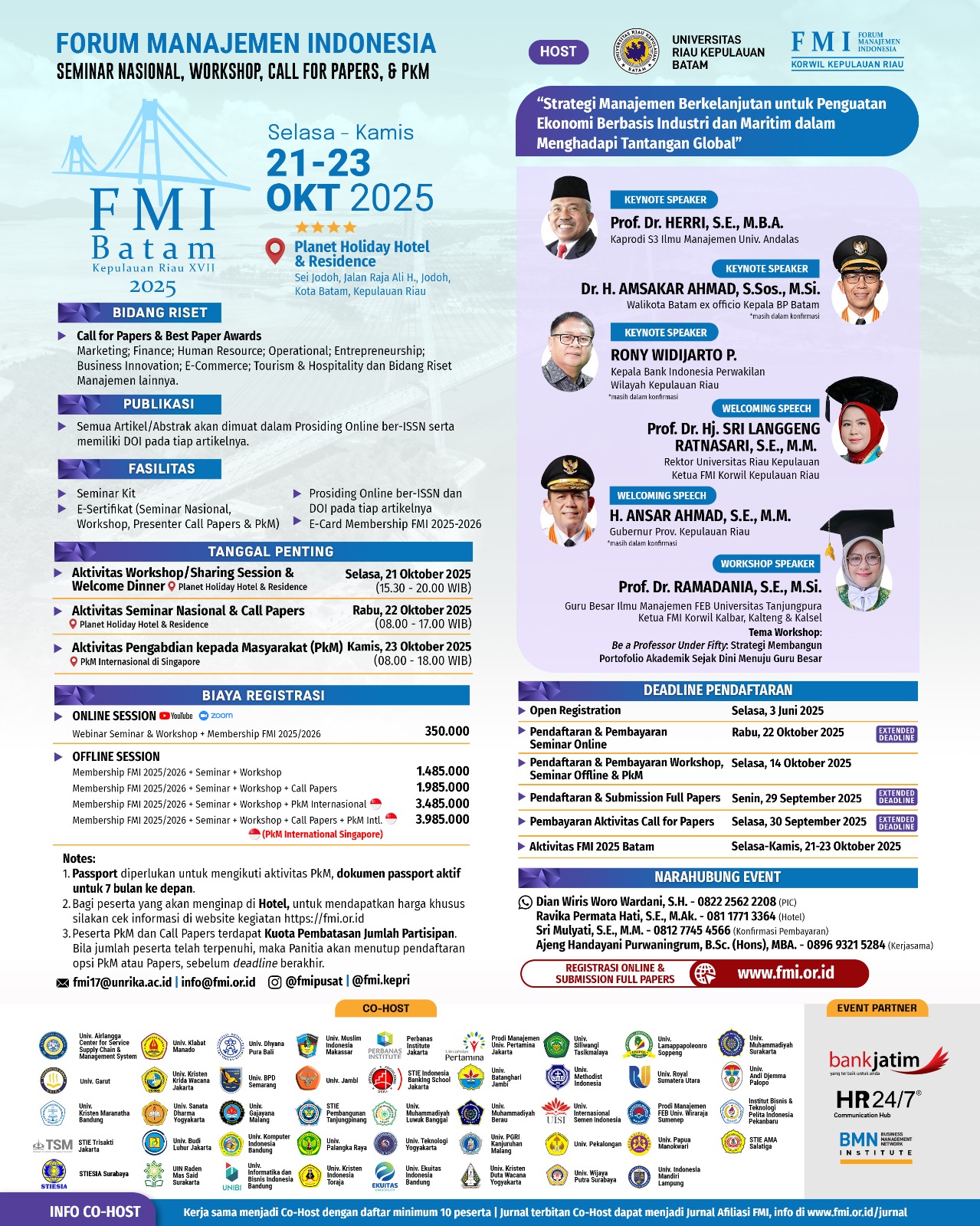
Halal Literacy and Social Factors in Predicting Intention to Use Halal Cosmetics with Logistic Regression
DOI:
https://doi.org/10.47747/snfmi.v3i1.3118Abstract
holding a strategic position as the world's largest Muslim-majority country. Despite its expansion, empirical studies predicting consumer intention to purchase halal cosmetics remain limited, especially those integrating halal literacy and demographic factors. This study examines the predictive role of halal literacy and socio-demographic variables (age, education, income, and marital status) on Indonesian consumers' intention. A quantitative cross-sectional survey involved 200 Muslim female respondents who had purchased halal cosmetics. Data were analyzed using binary logistic regression to estimate the probability of high purchase intention and evaluate each predictor's contribution. Model fit was tested with the Hosmer–Lemeshow test and Nagelkerke R² values. Results show that halal literacy is determinant of intention, with an odds ratio (OR) of 1.605, meaning each one-unit increase in literacy raises the likelihood of high intention by 60.5%. Demographic variables were not significant, although marital status showed a positive trend of nearly doubling purchase intention. The study contributes theoretically by extending the Theory of Planned Behavior with halal literacy and offers practical implications through consumer education.
References
Adiba, E. M., & Amir, F. (2023). Prediction of MSMEs interest for halal certification in Indonesia: Logistic regression approach. FALAH: Jurnal Ekonomi Syariah, 8(2), 18–31. https://doi.org/10.22219/jes.v8i2.24192
Adiba, E. M. (2019). Consumer purchasing behavior of halal cosmetics: A study on generations X and Y. Journal of Islamic Monetary Economics and Finance, 5(1), 169–192. https://doi.org/10.21098/jimf.v5i1.1052
Ajzen, I. (1991). The theory of planned behavior. Organizational Behavior and Human Decision Processes, 50(2), 179–211. https://doi.org/10.1016/0749-5978(91)90020-T
Ajzen, I., & Fishbein, M. (1972). Attitudes and normative beliefs as factors influencing behavioral intentions. Journal of Personality and Social Psychology, 21(1), 1–9. https://doi.org/10.1037/h0031930
Al-Ansi, A., Olya, H. G. T., & Han, H. (2019). Effect of general risk on trust, satisfaction, and recommendation intention for halal food. International Journal of Hospitality Management, 83, 210–219. https://doi.org/10.1016/j.ijhm.2018.10.017
Antara, P. M., Musa, R., & Hassan, F. (2016). Bridging Islamic financial literacy and halal literacy: The way forward in halal ecosystem. Procedia Economics and Finance, 37, 196–202. https://doi.org/10.1016/S2212-5671(16)30113-7
Aoun, I., & Tournois, L. (2015). Building holistic brands: An exploratory study of halal cosmetics. Journal of Islamic Marketing, 6(1), 109–132. https://doi.org/10.1108/JIMA-05-2014-0035
Bhutto, M. Y., Ertz, M., Soomro, Y. A., Khan, M. A., & Ali, W. (2022). Adoption of halal cosmetics: Extending the theory of planned behavior with moderating role of halal literacy (Evidence from Pakistan). Journal of Islamic Marketing, 13(9), 1895–1918. https://doi.org/10.1108/JIMA-09-2021-0295
Credence Research. (2023a). Indonesia halal cosmetics market size, share, growth, trends analysis report 2022–2025. Credence Research. https://www.credenceresearch.com/report/indonesia-halal-cosmetics-market
Credence Research. (2023b). South East Asia halal skincare market size, share, and forecast 2023–2032. Credence Research. https://www.credenceresearch.com/report/south-east-asia-halal-skincare-market
Gursoy, D., Altinay, L., & Kenebayeva, A. (2017). Religiosity and entrepreneurship behaviors. International Journal of Hospitality Management, 67, 87–94. https://doi.org/10.1016/j.ijhm.2017.08.005
Hair, J. F., Black, W. C., Babin, B. J., & Anderson, R. E. (2019). Multivariate data analysis (8th ed.). Cengage Learning.
Handriana, T., Yulianti, P., Kurniawati, M., Arina, N. A., Aisyah, R. A., Aryani, M. G. A., & Wandira, R. K. (2020). Purchase behavior of millennial female generation on halal cosmetic products. Journal of Islamic Marketing, 12(8), 1459–1478. https://doi.org/10.1108/JIMA-11-2019-0235
Khan, N., Sarwar, A., & Tan, B. C. (2020). Determinants of purchase intention of halal cosmetic products among Generation Y consumers. Journal of Islamic Marketing, ahead-of-print(ahead-of-print). https://doi.org/10.1108/JIMA-11-2019-0248
Ngah, A. H., Gabarre, S., Han, H., Rahi, S., Al-Gasawneh, J. A., & Park, S.-h. (2021). Intention to purchase halal cosmetics: Do males and females differ? A multigroup analysis. Cosmetics, 8(1), 19. https://doi.org/10.3390/cosmetics8010019
Nguyen, T. N., Lobo, A., & Greenland, S. (2025). Predicting intention to consume halal food: Extending TPB with ethics and halal literacy. Journal of Islamic Marketing, 16(2), 221–239. https://doi.org/10.1108/JIMA-12-2021-0399
Rahman, A. A., Asrarhaghighi, E., & Ab Rahman, S. (2015). Consumers and halal cosmetic products: Knowledge, religiosity, attitude and intention. Journal of Islamic Marketing, 6(1), 148–163. https://doi.org/10.1108/JIMA-09-2013-0068
Soon, J. M., & Wallace, C. A. (2017). Application of theory of planned behavior in purchasing intention and consumption of halal food. Nutrition & Food Science, 47(5), 635–647. https://doi.org/10.1108/NFS-03-2017-0059
Sudarsono, H., Ikawati, R., Azizah, S. N., Sujono, R. I., & Fitriyani, Y. (2024). Muslim Generation Z's purchase intention of halal cosmetic products in Indonesia. Innovative Marketing, 20(4), 13–24. https://doi.org/10.21511/im.20(4).2024.02
The Business Research Company. (2024). Halal cosmetics global market report 2024. The Business Research Company. https://www.thebusinessresearchcompany.com/report/halal-cosmetics-global-market-report
Vanany, I., Soon, J. M., Maryani, A., & Wibawa, B. M. (2020). Determinants of halal-food consumption in Indonesia. Journal of Islamic Marketing, 11(2), 507–521. https://doi.org/10.1108/JIMA-09-2018-0177