Pengaruh Perceived Organizational Support dan Work Life Balance terhadap Employee Engagement Dosen Perguruan Tinggi
DOI:
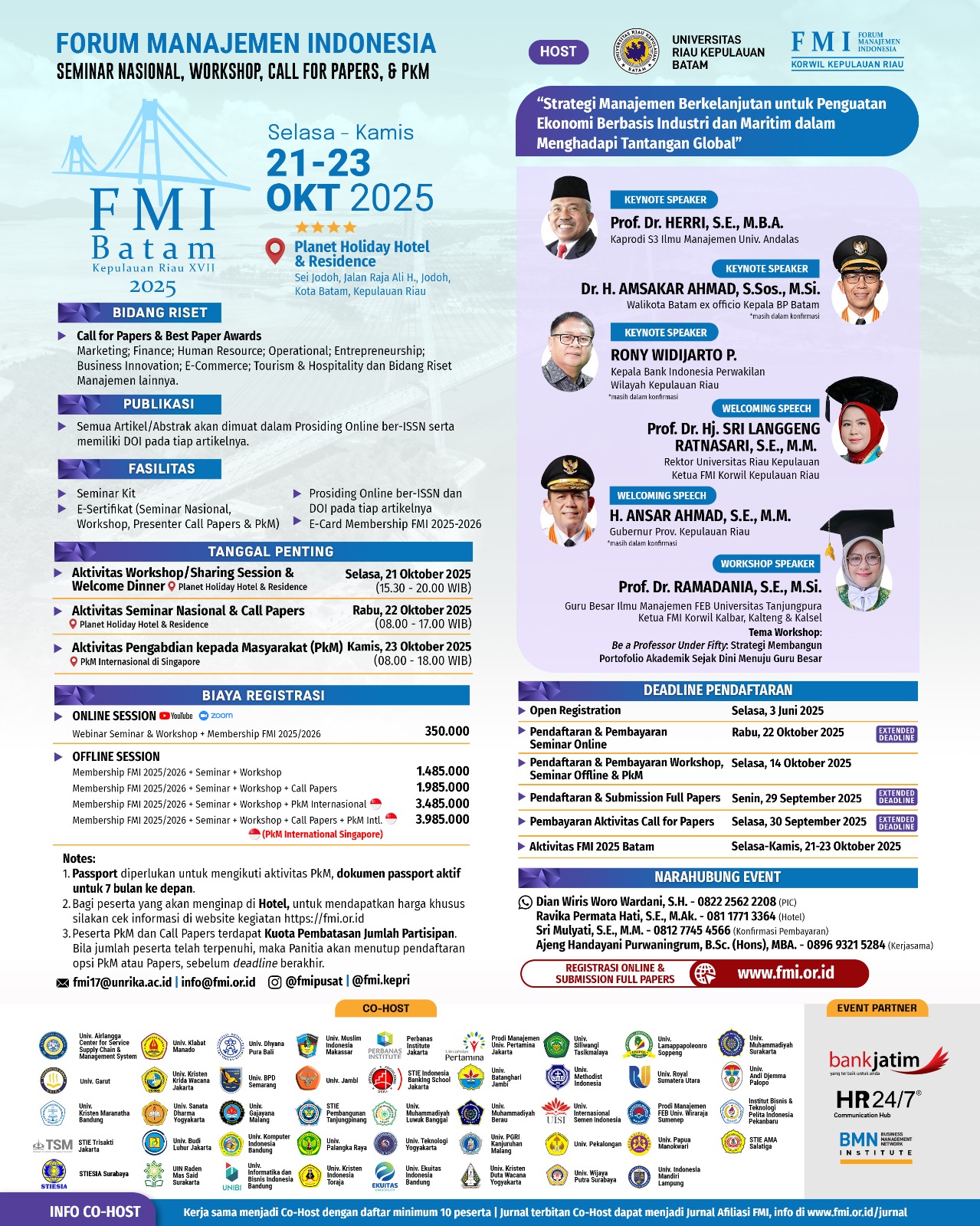
https://doi.org/10.47747/snfmi.v3i1.3153Abstract
This study aims to determine the effects of perceived organizational support and work-life balance on the dimensions of employee engagement—vigor, dedication, and absorption—among university lecturers in Indonesia. Data were obtained by distributing questionnaires to 170 university lecturers in Java and Sulawesi. The results showed that perceived organizational support positively affected all three dimensions of employee engagement. However, work-life balance had a positive effect only on vigor, with no effect on dedication or absorption. Perceived organizational support can be utilized to improve employee engagement among university lecturers.
References
Ahmed, I., Nawaz, M. M., Ali, G., & Islam, T. (2015). Perceived organizational support and its outcomes: A meta-analysis of latest available literature. Management Research Review, 38(6), 627–639. https://doi.org/10.1108/MRR-09-2013-0220
Bakker, A. B., & Demerouti, E. (2014). Job demands-resources theory. In Work and wellbeing, Vol. III (pp. 37–64). Wiley Blackwell. https://doi.org/10.1002/9781118539415.wbwell019
Björk-Fant, J. M., Bolander, P., & Forsman, A. K. (2023). Work-life balance and work engagement across the European workforce: A comparative analysis of welfare states. European Journal of Public Health, 33(3), 430–434. https://doi.org/10.1093/eurpub/ckad046
Caesens, G., Stinglhamber, F., & Ohana, M. (2016). Perceived organizational support and well-being: A weekly study. Journal of Managerial Psychology, 31(7), 1214–1230. https://doi.org/10.1108/JMP-01-2016-0002
Clark, S. C. (2000). Work/family border theory: A new theory of work/family balance. Human Relations, 53(6), 747–770. https://doi.org/10.1177/0018726700536001
Eisenberger, R., Huntington, R., Hutchison, S., & Sowa, D. (1986). Perceived organizational support. Journal of Applied Psychology, 71(3), 500–507. https://doi.org/10.1037/0021-9010.71.3.500
Elamin, A. M., Aldabbas, H., Ahmed, A. Z. E., & Abdullah, A. N. (2024). Employee Engagement and Innovative Work Behavior: The Mediating Role of Knowledge-Sharing Behavior in the United Arab Emirates (UAE) Service Context. Administrative Sciences, 14(9), Article 9. https://doi.org/10.3390/admsci14090232
Hair Jr, J. F., Sarstedt, M., Hopkins, L., & G. Kuppelwieser, V. (2014). Partial least squares structural equation modeling (PLS-SEM): An emerging tool in business research. European Business Review, 26(2), 106–121. https://doi.org/10.1108/EBR-10-2013-0128
Fisher, G. G., Bulger, C. A., & Smith, C. S. (2009). Beyond work and family: A measure of work/nonwork interference and enhancement. Journal of Occupational Health Psychology, 14(4), 441–456. https://doi.org/10.1037/a0016737
George, D., & Mallery, P. (2010). SPSS for Windows Step by Step: A Simple Guide and Reference, 17.0 Update. Allyn & Bacon.
Greenhaus, J. H., & Allen, T. D. (2011). Work–family balance: A review and extension of the literature. In Handbook of occupational health psychology, 2nd ed (pp. 165–183). American Psychological Association. https://doi.org/10.1037/10474-000
Hair, J. F., Hult, G. T. M., Ringle, C. M., & Sarstedt, M. (2017). A primer on partial least squares structural equation modeling (PLS-SEM) (Second edition). SAGE.
Henseler, J., Ringle, C. M., & Sarstedt, M. (2015). A new criterion for assessing discriminant validity in variance-based structural equation modeling. Journal of the Academy of Marketing Science, 43(1), 115–135. https://doi.org/10.1007/s11747-014-0403-8
Inggamara, A., Pierewan, A. C., & Ayriza, Y. (2022). Work–life balance and social support: The influence on work engagement in the Sixth European Working Conditions Survey. Journal of Employment Counseling, 59(1), 17–26. https://doi.org/10.1002/joec.12175
Kahn, W. A. (1990). Psychological Conditions of Personal Engagement and Disengagement at Work. Academy of Management Journal.
Katili, P. B., Wibowo, W., & Akbar, M. (2021). The Effects of Leaderships Styles, Work-Life Balance, and Employee Engagement on Employee Performance. Quantitative Economics and Management Studies, 2(3), 199–205. https://doi.org/10.35877/454RI.qems319
Katsaros, K. K. (2024). Remote employee work performance in the meta COVID-19 era: Evidence from Greece. International Journal of Productivity and Performance Management, 74(1), 340–357. https://doi.org/10.1108/IJPPM-09-2023-0492
Mori, K., Adi, N. P., Odagami, K., & Nagata, T. (2024). Bridging perceived organizational support with learning motivation and work engagement: The mediating role of focus on opportunity. Journal of Occupational Health, 66(1), uiae024. https://doi.org/10.1093/joccuh/uiae024
Mufarrikhah, J. L., Yuniardi, M. S., & Syakarofath, N. A. (2020). Peran Perceived Organizational Support terhadap Work Engagement Karyawan. Gadjah Mada Journal of Psychology (GamaJoP), 6(2), Article 2. https://doi.org/10.22146/gamajop.56396
Neuber, L., Englitz, C., Schulte, N., Forthmann, B., & Holling, H. (2022). How work engagement relates to performance and absenteeism: A meta-analysis. European Journal of Work and Organizational Psychology, 31(2), 292–315. https://doi.org/10.1080/1359432X.2021.1953989
Parkes, L. P., & Langford, P. H. (2008). Work–life bal ance or work–life alignment? A test of the importance of work-life balance for employee engagement and intention to stay in organisations. Journal of Management & Organization, 14(3), 267–284. https://doi.org/10.5172/jmo.837.14.3.267
Rhoades, L., & Eisenberger, R. (2002). Perceived organizational support: A review of the literature. Journal of Applied Psychology, 87(4), 698–714. https://doi.org/10.1037/0021-9010.87.4.698
Schaufeli, W. B. (2017). Applying the Job Demands-Resources model: A ‘how to’ guide to measuring and tackling work engagement and burnout. Organizational Dynamics, 46(2), 120–132. https://doi.org/10.1016/j.orgdyn.2017.04.008
Schaufeli, W. B., Salanova, M., González-Romá, V., & Bakker, A. B. (2002). The measurement of engagement and burnout: A two sample confirmatory factor analytic approach. Journal of Happiness Studies: An Interdisciplinary Forum on Subjective Well-Being, 3(1), 71–92. https://doi.org/10.1023/A:1015630930326
Tian, L., Wu, A., Li, W., Huang, X., Ren, N., Feng, X., & Zhang, Y. (2023). Relationships Between Perceived Organizational Support, Psychological Capital and Work Engagement Among Chinese Infection Control Nurses. Risk Management and Healthcare Policy, 16, 551–562. https://doi.org/10.2147/RMHP.S395918
Zhu, L.-L., Wang, H.-J., Xu, Y.-F., Ma, S.-T., & Luo, Y.-Y. (2023). The effect of work engagement and perceived organizational support on turnover intention among nurses: A meta-analysis based on the Price–Mueller model. Journal of Nursing Management, 2023. https://doi.org/10.1155/2023/3356620